At ArbCert, we provide professional tree root investigation, barrier installation and damage assessments to help protect buildings, driveways, retaining walls, pools, underground services and other infrastructure from costly damage.
If you are experiencing or concerned about tree root damage, our AQF Level 5 Consulting Arborists can inspect the site, investigate the cause and recommend practical solutions that protect both your property and the long-term health of the tree.
When professionally designed and installed, root barrier systems are a highly effective solution for managing invasive tree roots, particularly beneficial in urban environments where space is limited and infrastructure protection is essential.
Whether you’re a homeowner, strata manager, commercial property owner or developer, ArbCert offers expert arboricultural advice to deliver tailored root management solutions.
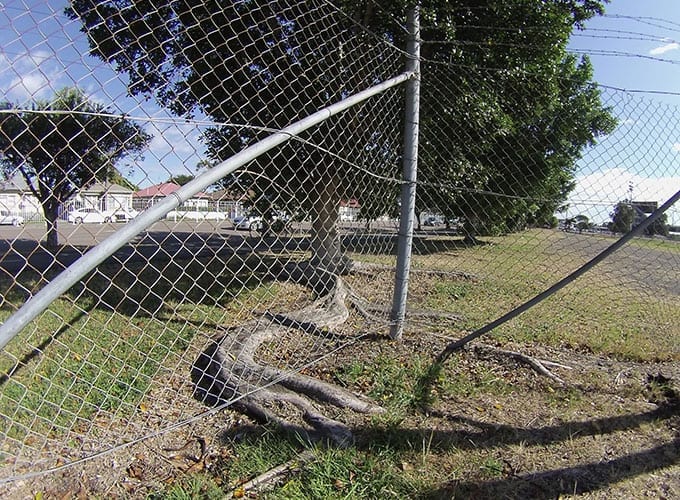
A root barrier system is designed to redirect tree roots away from structures, reducing the risk of damage to foundations, driveways, retaining walls, swimming pools, underground pipes and landscaped areas. The barrier intercepts root growth and guides it away from sensitive infrastructure, preventing further extension while maintaining a healthy rooting environment for the tree.
Root barriers are typically installed by digging a narrow trench and inserting a subsurface barrier made from durable polyurethane or reinforced plastic. This proven method is widely accepted for managing root growth in urban and developed environments and helps minimise future root conflicts while reducing the likelihood of expensive structural repairs. It can also help prevent tree roots from invading nearby damaged plumbing and underground pipework, reducing the risk of blockages and damage. During installation, careful consideration is given to preserving important structural roots to maintain tree stability and health.
At ArbCert, every installation is designed specifically for the tree species, soil conditions and surrounding infrastructure to ensure long-term performance and compliance with best-practice arboricultural standards.
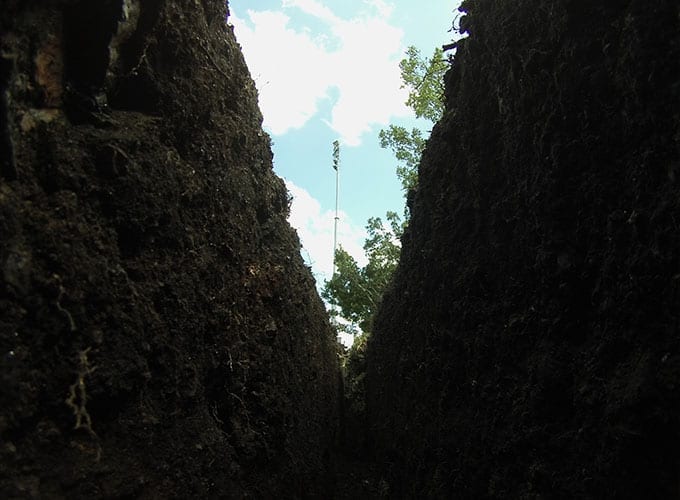
Understanding the location and extent of a tree’s root system is essential when planning new developments, landscaping or resolving conflicts between trees and infrastructure. Where there are concerns about root intrusion into nearby structures, a professional risk assessment helps determine the likelihood of damage and guides appropriate management decisions. ArbCert offers expert root investigation and mapping services to accurately determine the location, depth and extent of a tree’s root system, plus tree health and stability.
Our tree root damage reports map root systems, assess root condition and provide detailed findings to support informed decision-making. These reports can assist property owners, builders, engineers and councils with insurance claims, engineering assessments, construction applications, neighbour disputes and property maintenance decisions.
We use a range of investigation methods suited to site conditions, including non-destructive air spading and careful hand excavation. Air spading uses compressed air to safely expose tree roots without causing unnecessary damage, making it ideal for protected trees and sensitive sites. Root mapping also helps identify hidden defects within the root system that may compromise tree stability or increase the risk of tree collapse.
Our AQF Level 5 Consulting Arborists provide accurate root mapping and detailed reporting in accordance with AS 4970-2025 – Protection of Trees on Development Sites.
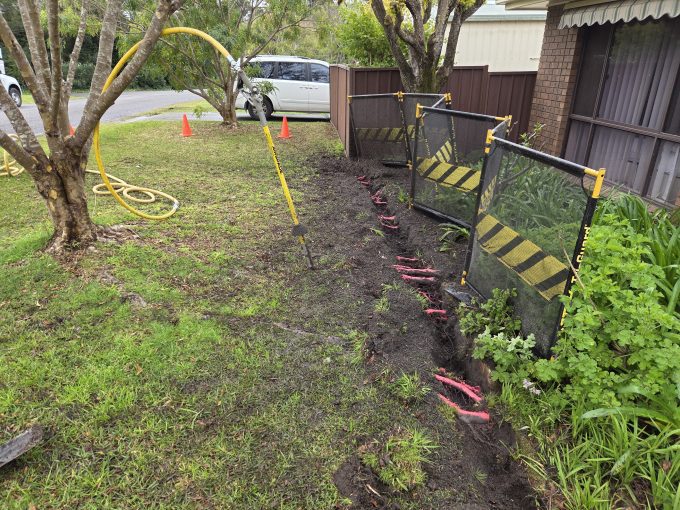
We proudly service Port Stephens, Maitland, Lake Macquarie, the Hunter Valley, and Newcastle. Contact ArbCert today to schedule your inspection or root mapping assessment and protect both your trees and infrastructure.
Contact UsMost root barriers are installed between 600mm and 1.2m deep, depending on the tree species, soil conditions and nearby infrastructure. The correct depth helps redirect roots away from structures while maintaining tree stability.
Tree roots cannot be stopped from growing, but they can be professionally managed. Root barriers, selective root pruning, ongoing monitoring and soil management can significantly reduce the risk of tree root damage while avoiding tree removal and maintaining the health of the tree.
A root barrier system helps protect driveways, foundations, retaining walls, pipes, and landscaped surfaces from costly damage caused by invasive roots. It allows the tree to remain in place while preventing conflict with surrounding structures, making it a practical solution that supports tree retention rather than removal.
Root barriers are commonly used by homeowners, developers, councils, schools and commercial property managers where trees are growing close to buildings or infrastructure and root damage is a concern. They are especially important where tree protection is required and in urban areas where space is limited and infrastructure protection is a priority.
Our AQF Level 5 consulting arborists begin with a site inspection and tree root investigation to determine whether a root barrier is appropriate. A narrow trench is then carefully excavated and a durable barrier is installed at the correct depth and alignment. The process is designed to be safe, efficient and compliant with best-practice arboricultural standards.
A tree root investigation identifies the location, depth and spread of tree roots to determine whether they are causing or are likely to cause damage to nearby structures. Root investigations are also recommended where trees show signs of possible root-related issues, such as canopy dieback, an unexpected lean or reduced stability, to determine whether root crown or structural root damage may be contributing to these symptoms. At ArbCert, we use non-destructive methods, including air spading and hand excavation, to expose roots safely before preparing detailed findings and recommendations.
Responsibility for tree root damage in NSW depends on the specific circumstances of each case, including the location of the tree, the nature of the damage and applicable legislation. A professional tree root investigation is often the first step in determining whether tree roots are contributing to the reported damage. ArbCert provides independent arboricultural assessments and detailed reports to assist property owners, engineers, insurers and legal representatives in understanding the relationship between tree roots and surrounding infrastructure.

Our team includes AQF Level 5 and Level 8 consulting arborists with extensive industry experience. We deliver technically robust advice that is reliable, defensible and aligned with current Australian Standards.
We deliver high-quality arborist reports that meet council and regulatory requirements, supporting smooth approvals and informed decision-making.
Our experienced arborists take a straightforward, collaborative approach to every report, ensuring you receive clear communication and practical guidance every step of the way.