Common tree defects such as cracks, cavities, decay, dead branches and root damage can raise concerns about tree safety. However, a defect does not necessarily mean that a tree is dangerous or requires removal.
Trees are living structures that change throughout their lives. Mature trees commonly develop hollows, wounds, deadwood, multiple stems and other structural features. Many continue to remain healthy and structurally suitable.
A qualified arborist considers each feature in the context of the whole tree. They also consider the surrounding environment and what could be affected if a branch or the tree were to fail.
Understanding some common tree defects can help property owners recognise when they should seek professional arborist advice.
Mushrooms or other fungal fruiting bodies around the base, trunk or branches of a tree can indicate decay.
However, not all fungi have the same significance. Some fungi colonise dead or dysfunctional wood. Others may affect important structural roots, trunks or branches.
An arborist will consider the fungal species, its location and the condition of the surrounding wood. They will also assess the overall health and structure of the tree.
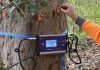
Sometimes a visual inspection cannot determine the full extent of internal decay. In these cases, an arborist may recommend further investigation using specialist tree diagnostic equipment.
Tree cavities and hollows commonly occur in mature trees. Their presence does not automatically make a tree structurally unsafe.
Trees can continue to grow functional wood around cavities and hollows. Many trees remain structurally suitable for long periods despite these features.
An arborist may assess the size and location of the cavity and the amount of remaining wood. They may also consider woundwood development, associated decay and the loading on the affected part of the tree.
Large or changing cavities may require further assessment. This becomes more important where a potential failure could affect people, buildings or frequently occupied areas.
Cracks can develop in trunks, branches and unions between stems.
Some cracks remain relatively stable for long periods. Others can indicate recent movement or an increased likelihood of structural failure.
Fresh cracking, movement between stems or changes to an existing crack may warrant closer assessment. Associated decay can also increase the significance of the feature.
An arborist will consider the location and extent of the crack. They will also assess the surrounding wood and the mechanical loading on that part of the tree.
Dead branches are a normal feature of many trees, particularly large mature trees.
Deadwood does not automatically create an unacceptable risk. Its significance depends on the size and condition of the branch, its height and what lies beneath it.
For example, a large dead branch above a playground or pedestrian area may require management. A similar branch over an area with little or no occupancy may present substantially less risk.
Deadwood can also provide valuable habitat. Arborists should therefore consider both risk and ecological value before recommending removal.
Trees commonly develop multiple stems or large codominant branches. Multiple stems alone do not make a tree defective or unsafe.
However, some unions have structural characteristics that require closer assessment.
An arborist may look for included bark, cracks, decay or unusual movement. They will also consider the size, orientation and loading of the stems.
These factors help determine whether the union requires management or simply ongoing observation.
A leaning tree is not necessarily a dangerous tree.
Many trees develop a natural lean as they grow towards light or respond to their environment. A long-standing lean can differ significantly from a tree that has recently moved.
Fresh soil cracking, root plate movement or exposed roots may indicate instability. A noticeable recent change in the tree’s position can also cause concern.
A qualified arborist should promptly assess a tree that appears to have moved recently, especially where it could affect people or property.
Tree roots provide structural support and supply the canopy with water and nutrients.
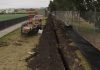
Excavation, trenching and construction can damage roots. Soil compaction, changes in ground level, decay and physical root severance can also affect the root system.
The significance of root damage depends on several factors. These include the size and location of the affected roots and the proportion of the root system involved.
Tree species, soil conditions and the condition of the remaining roots also influence the outcome.
Where an arborist suspects significant structural root damage, they may recommend further investigation. This can help determine the extent of the damage and its effect on tree health or stability.
Trees can sustain wounds from vehicles, machinery, construction work, pruning and branch failure.
Trees do not heal damaged tissue in the same way as people or animals. Instead, they grow new tissue around damaged areas and compartmentalise injured or dysfunctional tissue.
Many trees successfully accommodate wounds. However, some wounds damage important structural tissues or contribute to the development of decay.
An arborist can assess the location and extent of the damage. They can then determine whether the tree requires monitoring or further investigation.
Bulges and unusual wood growth can develop around wounds, branch unions and cavities.
Trees can also produce additional wood in response to mechanical loading and changes in stress.
A bulge does not automatically indicate that a tree is unsafe. However, unusual growth patterns can provide useful information about the tree’s structural history.
An arborist may examine these areas for wounds, decay or changes in loading before determining their significance.
A tree that has lost a branch is not necessarily likely to fail again.
The reason for the previous failure is often more important than the failure itself.
An arborist may examine the failure point for decay, wounds or structural defects. They may also inspect branch attachments and other areas of the canopy for similar characteristics.
Previous failure becomes more relevant where the same failure mechanism remains elsewhere in the tree.
Storms and severe weather can damage branches, trunks and tree canopies.
Some damage is obvious from the ground. Other defects may occur high in the canopy and can be difficult to see.
Keep people clear of trees with hanging branches, recent movement or obvious structural damage. A qualified arborist can then assess the tree and determine whether further action is required.
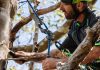
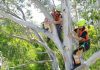
Where ground-based inspection cannot adequately assess an important feature, an arborist may recommend an aerial tree inspection.
Branches do not automatically require pruning simply because they extend over a house or roof.
An arborist should base pruning recommendations on the condition and structure of the branch. They should also consider the likelihood and consequences of failure.
Other legitimate management objectives may also influence the decision.
Unnecessary pruning can remove healthy foliage and alter tree structure without meaningfully reducing risk.
If large branches over a house cause concern, an arborist can assess whether pruning, monitoring or no intervention is appropriate.
Consider seeking professional arborist advice when you notice a significant or recent change in a tree. This becomes particularly important near people, buildings or other valuable assets.
Signs that may warrant further assessment include:
Keep people away from trees that show signs of immediate instability or partially failed branches. Arrange an appropriate assessment before allowing normal access to the affected area.
A professional tree assessment involves more than identifying a list of defects.
A qualified arborist considers the tree’s species, size, health and structure. They also assess its surroundings and the significance of any identified defects.
Importantly, tree risk also depends on what could be affected if failure occurred.
For example, a structural feature above a frequently occupied area may require different management from the same feature in an isolated location.
The arborist can then recommend a proportionate response. This may include monitoring, pruning, further investigation, restricting access or modifying the surrounding environment.
Some trees require more detailed investigation before an arborist can reach a reliable conclusion. Further assessment may include aerial inspection, root investigation or specialist decay-detection techniques.
Tree removal is only one potential management response. A qualified arborist should recommend removal only where the assessment justifies it.
Recognising common tree defects can help property owners identify when they should seek further advice. However, individual features should not be considered in isolation.
Cavities, deadwood, fungi, multiple stems, wounds and decay can occur in trees that remain suitable for retention.
Professional tree risk assessment considers the significance of these features in the context of the individual tree and its surroundings. The arborist can then recommend proportionate management where necessary.
ArbCert’s qualified consulting arborists assess trees across residential properties, schools, commercial sites, public spaces and larger tree populations. Our assessments provide evidence-based recommendations to support informed and practical tree management decisions.