DIY tree removal can look straightforward, particularly when a tree is relatively small or appears easy to access. In practice, tree removal can involve significant risks to people, buildings, vehicles and surrounding property.
Trees are heavy, irregular structures. Their branches and trunks can move unpredictably once cut, particularly where decay, defects, lean or uneven canopy weight affect their behaviour.
Before attempting to remove or substantially prune a tree yourself, it is important to understand the risks and when professional assistance is appropriate.
Tree removal involves much more than making a cut at the base of a trunk.
An arborist or qualified tree worker must consider factors such as:
Even relatively small branches can weigh considerably more than expected.
Once a branch or trunk section begins to move, there may be little opportunity to correct its direction.
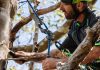
Chainsaws require appropriate training, protective equipment and an understanding of how wood behaves while cutting.
Using a chainsaw from a ladder introduces additional hazards. The operator may lose balance, the branch may move unexpectedly or the saw may react when the cut closes or timber shifts.
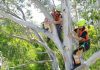
Tree work at height can require specialist climbing systems, elevated work platforms and controlled rigging techniques.
Professional tree workers use these systems to manage both the person performing the work and the sections of tree being removed.
Predicting exactly how a branch will move after cutting can be difficult.
Branches may rotate, swing towards the trunk or strike another part of the canopy before reaching the ground. They may also bounce or roll after impact.
Where trees grow close to houses, fences, vehicles or neighbouring property, even a relatively small error can cause substantial damage.
Professional tree contractors can use ropes, rigging systems and other techniques to control sections of a tree where free-falling material would create an unacceptable risk.
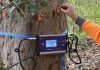
Decay, cavities, cracks, damaged roots and weak branch unions can affect how a tree responds during removal.
A tree may also contain defects that are not obvious from ground level.
These features can change the strength of trunks or branches and may affect the direction or timing of failure once cutting begins.
If there is uncertainty about a tree’s structural condition, a professional arboricultural assessment may help determine the significance of the defects before work proceeds.
Before arranging removal, it is worth determining whether removal is necessary.
A cavity, lean, dead branch or fungal fruiting body does not automatically mean that a tree is unsafe.
Depending on the tree and its surroundings, suitable management may include:
A qualified consulting arborist can provide an independent assessment where there is uncertainty about a tree’s condition or the need for removal.
Where tree removal or significant pruning is required, use a suitably qualified and experienced tree contractor.
The contractor should have the skills, equipment and safety systems appropriate to the size and complexity of the work.
For more complex trees, this may involve qualified climbing arborists, elevated work platforms, rigging equipment and additional ground crew.
Property owners should also check whether council approval or another form of consent is required before removing a tree.
A consulting arborist can help where the main question is not how to remove a tree, but whether removal is necessary in the first place.
Professional assessment may be useful where:
ArbCert provides independent arboricultural assessment and reporting to help property owners make informed decisions about tree condition, risk and appropriate management.
Where practical tree pruning or removal is required, the work should then be undertaken by a suitably qualified tree contractor.